All Posts
Read production engineering posts as evidence with a scope and date.
Read production engineering posts as evidence with a scope and date. A company post can teach the problem, constraints, and selected mechanisms the authors chose to discuss. It rarely provides every component, consistency promise, current deployment detail, or operational metric. This index links six case studies and gives a disciplined reading method.
The mechanism at a glance
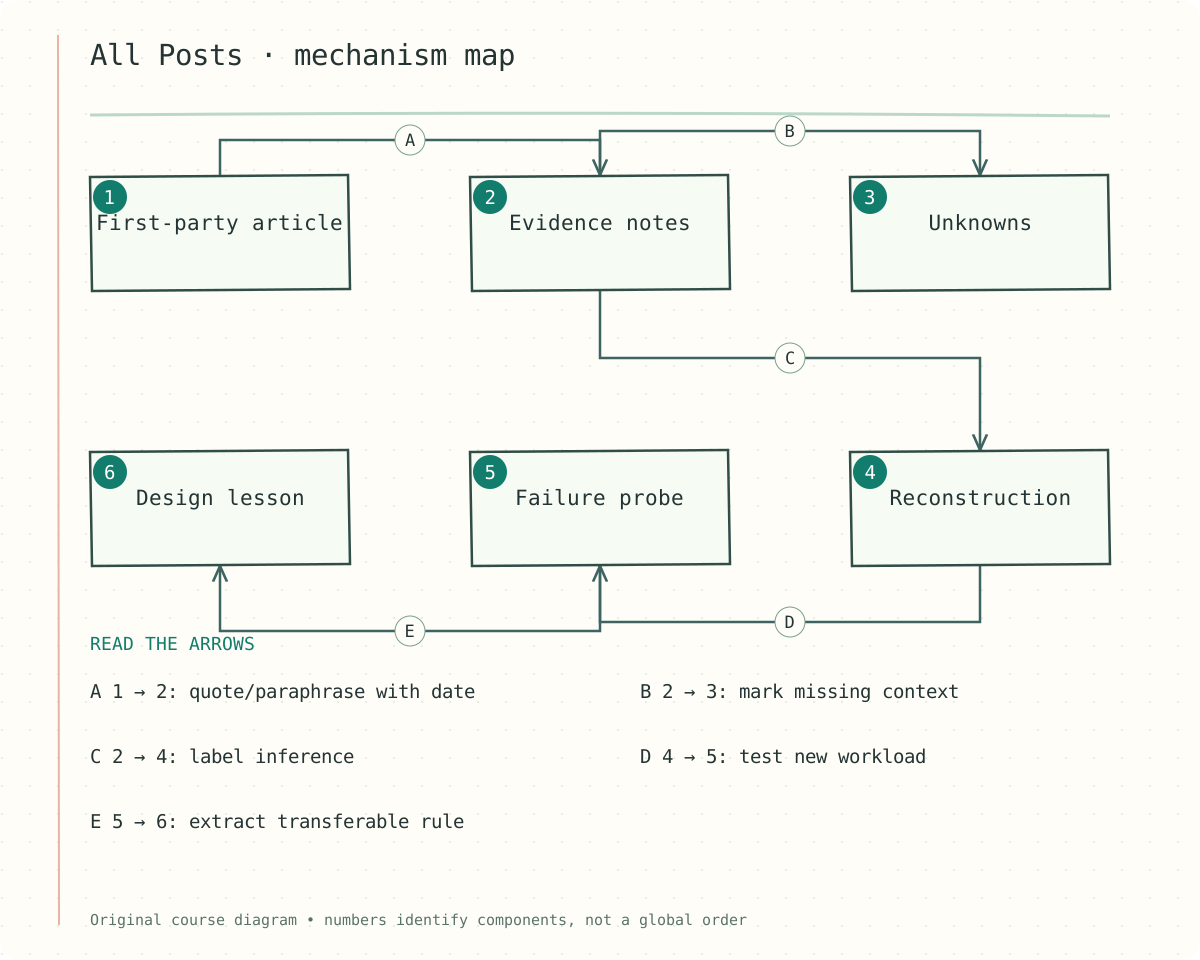
Figure — First-party article → Evidence notes (quote/paraphrase with date); Evidence notes → Unknowns (mark missing context); Evidence notes → Reconstruction (label inference); Reconstruction → Failure probe (test new workload); Failure probe → Design lesson (extract transferable rule)
The numbered components identify responsibilities. Follow the labeled arrows rather than treating the numbers as a global execution order. The scenario later in this lesson shows one concrete sequence.
Step-by-step reasoning
1. 1 · Frame
Shopify Inventory Reservations examines a published reservation design; Discord Message Storage describes chat-history storage and migration; Slack Job Queue describes queue scaling. Begin each article by noting its publication date, stated problem, and exact claims rather than copying the architecture into a new prompt.
2. 2 · Model
Figma Multiplayer explains collaborative editing concepts; Spotify Data Lake covers data-platform topics and a separate online point-query index article; Meta ZGateway describes a proxy role and resilience concerns. These posts span different dates and system boundaries, so compare mechanisms only after you identify the workload.
3. 3 · Scale
For each case, create two columns: “the article says” and “my interview reconstruction.” In the second, state assumptions, API, invariant, data model, failure path, and one metric. Link evidence to a specific first-party article and avoid treating inferred generic components as company facts.
4. 4 · Recover
Published architecture snapshots can age. Do not generalize one team’s mechanism to the whole company, infer current throughput from historical numbers, or assume a public post is exhaustive. Follow updated first-party articles for claims that may have changed. The linked chapter pages preserve these evidence boundaries.
Contracts and state
The following sketch makes the decision boundary concrete. Field names and capacity assumptions are illustrative; adapt them to the stated product contract.
Evidence -> publication date -> stated boundary -> extracted mechanism -> labeled inference -> interview exercise
Six case pages link to first-party engineering posts and identify what remains unknown.
Worked example
Reading the Slack queue case, record the article’s reported historical queue details with the publication context. Then independently design a queue for a new workload: define due time, lease, idempotency, fairness, and backlog recovery. These are distinct outputs.
Failure walkthrough
A reader draws a complete corporate topology from a selective engineering post and repeats an old throughput figure as a current limit. The remedy is attribution, dates, explicit unknowns, and a separate generic reconstruction tested against stated requirements.
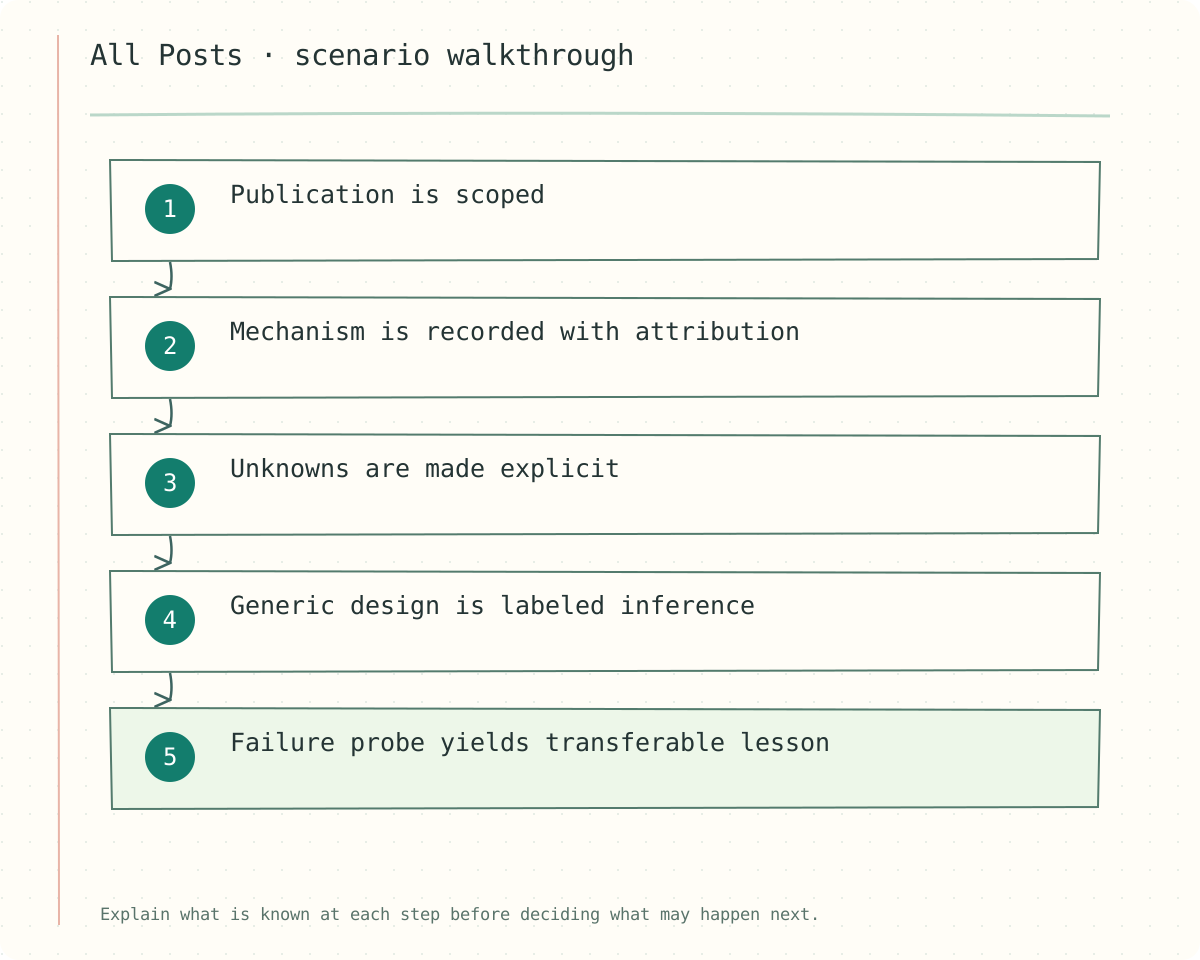
Figure — Publication is scoped → Mechanism is recorded with attribution → Unknowns are made explicit → Generic design is labeled inference → Failure probe yields transferable lesson
Decisions and trade-offs
| Case study | Primary article | Interview focus |
|---|---|---|
| Shopify Inventory Reservations | Shopify Engineering | Scarce inventory and holds |
| Discord Message Storage | Discord Engineering | History partitioning and migration |
| Slack Job Queue | Slack Engineering | Due work, leases, retry, backlog |
| Figma Multiplayer | Figma Engineering | Concurrent edits and reconnect |
| Spotify Data Lake | Spotify Engineering | Platform layers and derived indexes |
| Meta ZGateway | Meta Engineering | Admission, routing, resilience |
Check your understanding
Pick one linked case. Identify two claims the source supports, one key fact it does not disclose, and one generic failure scenario you would add in an interview.
Show answer and explanation
Answer: A well-supported reading attributes a claim and scope to the specific post, names a relevant unknown, then labels any proposed API or failure-handling mechanism as inference. Follow up by testing the reconstruction against a stated workload instead of treating it as an exact production map.
Open a chapter
Pick one linked case. Identify two claims the source supports, one key fact it does not disclose, and one generic failure scenario you would add in an interview.
Your design draft
Clarify assumptions, explain your approach, and test the difficult cases. Save your draft, then compare it with the study notes.
Self-review checklist
Self-guided practice. Automated AI feedback and code execution are not connected.