Common Patterns Overview
Patterns are reusable responses to recurring constraints.
Patterns are reusable responses to recurring constraints. Their names are useful only when paired with trigger conditions, state ownership, and a failure path. This page maps the seven pattern chapters to the question they help answer, then gives a compact selection method.
The mechanism at a glance
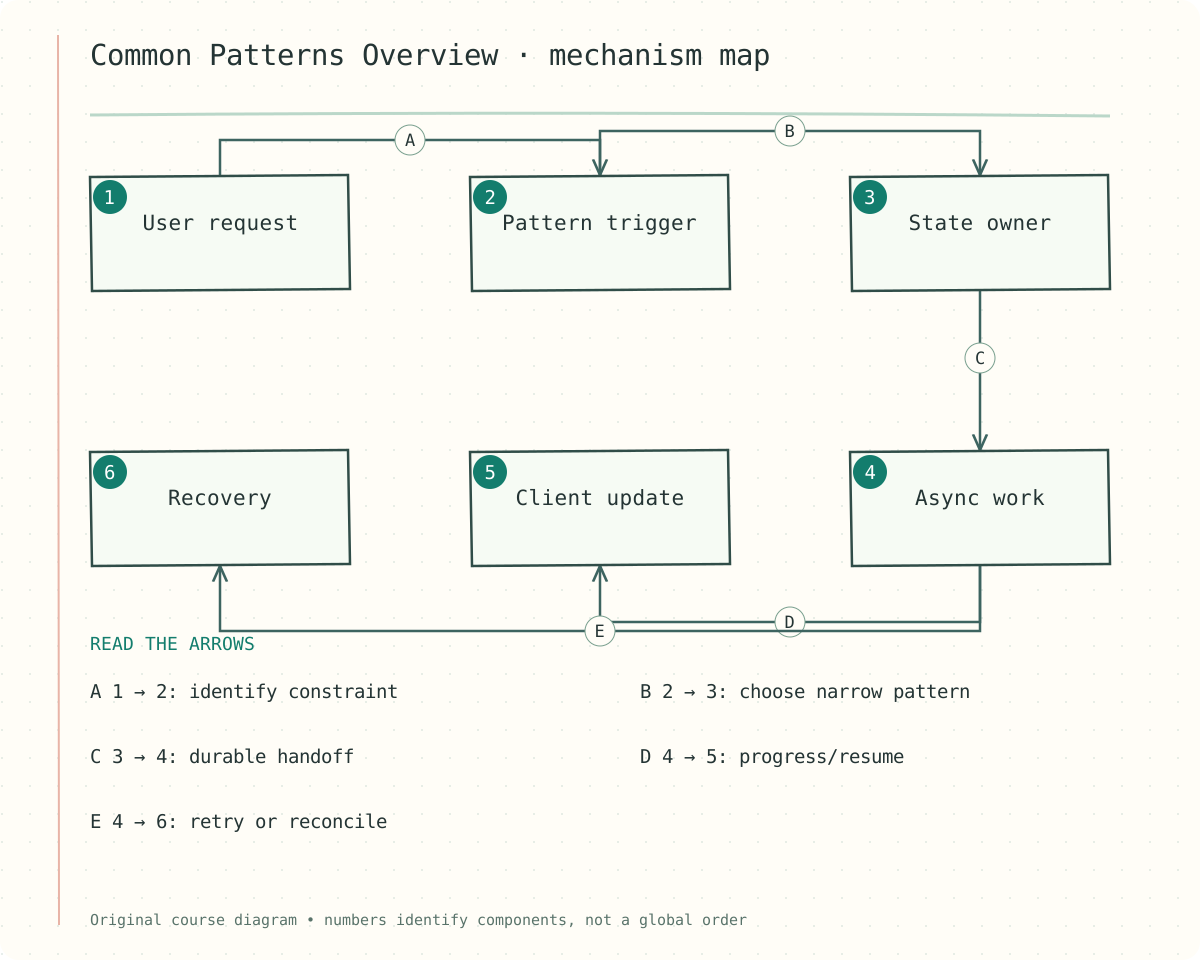
Figure — User request → Pattern trigger (identify constraint); Pattern trigger → State owner (choose narrow pattern); State owner → Async work (durable handoff); Async work → Client update (progress/resume); Async work → Recovery (retry or reconcile)
The numbered components identify responsibilities. Follow the labeled arrows rather than treating the numbers as a global execution order. The scenario later in this lesson shows one concrete sequence.
Step-by-step reasoning
1. 1 · Frame
Real-time Updates chooses how clients receive changes and resume after disconnect. Dealing with Contention protects a scarce or conflicting state transition. Multi-step Processes handles a workflow spanning durable steps. Start by naming whether the problem is delivery, conflict, or coordination.
2. 2 · Model
Scaling Reads covers replicas, caches, and materialized projections. Scaling Writes covers buffering, batching, and partitioning. Handling Large Blobs separates metadata from bulk transfer. Managing Long Running Tasks persists leases, heartbeats, checkpoints, and cancellation. Each requires a different durable boundary.
3. 3 · Scale
Select the smallest pattern that fixes a measured need. Write down the state owner, idempotency key, ordering scope, backlog or freshness limit, and recovery action. Then apply the pattern to a course case such as WhatsApp, Ticketmaster, Payment System, Dropbox, or LeetCode.
4. 4 · Recover
Patterns compose, but each adds operational work. A queue can absorb a write burst, yet it cannot increase sustainable downstream capacity by itself. A cache can reduce reads, yet it needs invalidation or freshness rules. A workflow engine can persist steps, yet business effects still need idempotency.
Contracts and state
The following sketch makes the decision boundary concrete. Field names and capacity assumptions are illustrative; adapt them to the stated product contract.
Trigger -> pattern -> authoritative state -> retry identity -> overload/failure behavior
Delivery: push/poll + resume
Conflict: conditional write/lock/queue
Workflow: durable state machine + compensation
Scale: bounded queues, projections, blob transfer, task leases
Worked example
A video upload has a large object and a long-running transcode. Handling Large Blobs separates multipart transfer from metadata; Managing Long Running Tasks records transcode state and retries; Real-time Updates reports progress. Their boundaries remain distinct: upload completion does not mean encoding completed.
Failure walkthrough
A team adds a queue to a dependency already processing below arrival rate. Queue depth grows without bound. Scaling Writes only smooths bursts; add capacity, apply admission control, or reduce work until service rate can exceed arrivals over the recovery period.
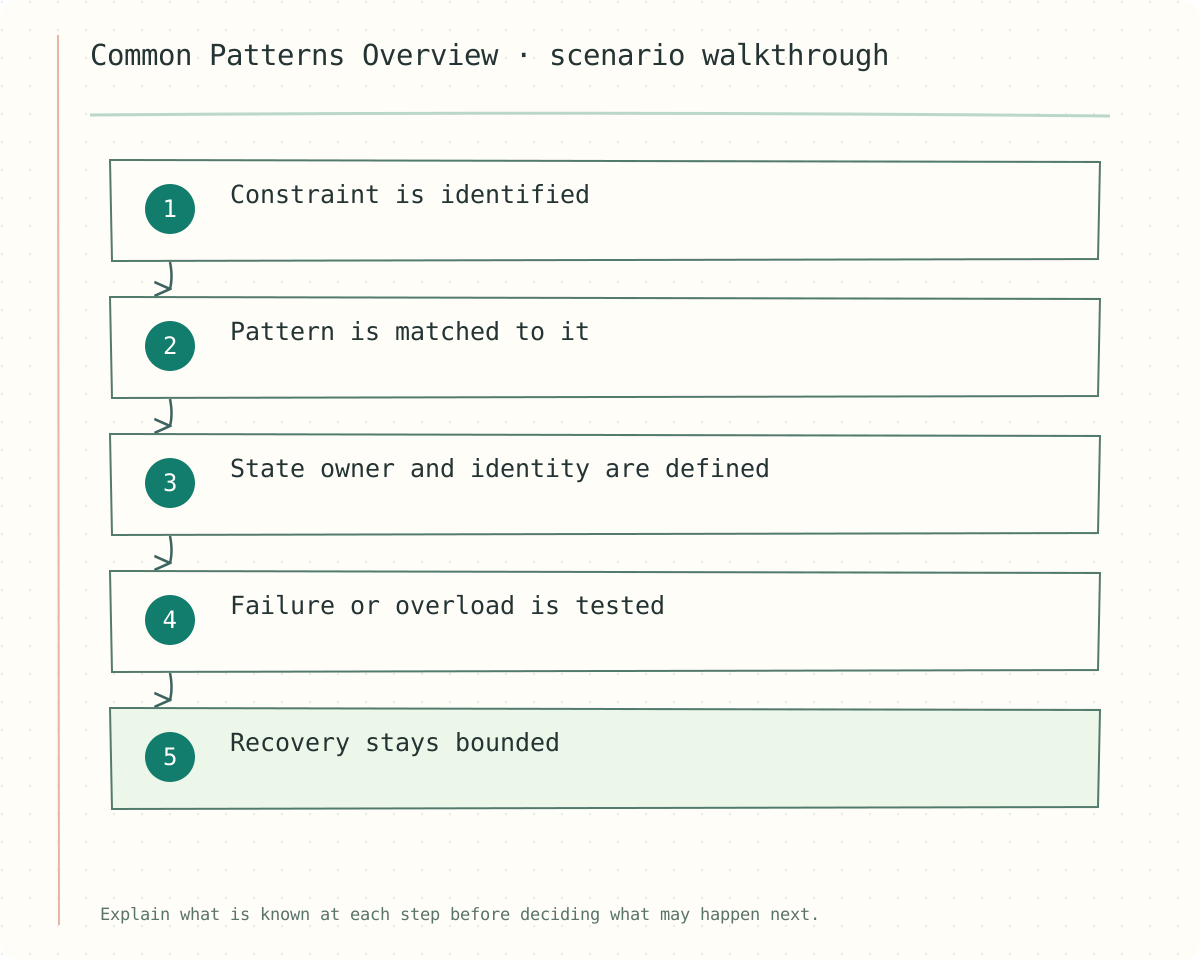
Figure — Constraint is identified → Pattern is matched to it → State owner and identity are defined → Failure or overload is tested → Recovery stays bounded
Decisions and trade-offs
| Need | Pattern | Required follow-up |
|---|---|---|
| Reconnectable client view | Real-time Updates | Resume cursor and retention |
| Exclusive decision | Dealing with Contention | Winner and loser responses |
| Durable multi-step work | Multi-step Processes | Compensation and duplicate effects |
| Read/write pressure | Scaling Reads/Writes | Freshness or backlog bound |
| Large transfer / long job | Large Blobs / Long Running Tasks | Cleanup, leases, cancellation |
Check your understanding
Choose two patterns for a media upload that creates a long-running encode and sends progress to a client. Identify which state each owns.
Show answer and explanation
Answer: Use Handling Large Blobs for resumable multipart transfer and metadata; Managing Long Running Tasks for durable encode attempts and recovery; Real-time Updates for client progress if needed. The upload object, job state, and client stream have separate contracts and failure boundaries.
Open a chapter
Choose two patterns for a media upload that creates a long-running encode and sends progress to a client. Identify which state each owns.
Your design draft
Clarify assumptions, explain your approach, and test the difficult cases. Save your draft, then compare it with the study notes.
Self-review checklist
Self-guided practice. Automated AI feedback and code execution are not connected.