Meta ZGateway
Meta describes ZGateway as a managed proxy tier before ZippyDB.
Meta describes ZGateway as a managed proxy tier before ZippyDB. It bounds connection fan-in, centralizes traffic management, and batches or coalesces compatible work. The account includes per-tenant admission, optional read caching, controlled rollout and regional routing. Database-client responsibilities are reused rather than independently reinvented. Published modeling numbers are illustrations in that account, not universal capacity limits. Source publication: 2026-09-03. The walkthrough below is an original interview exercise, not an undocumented claim about the company.
The mechanism at a glance
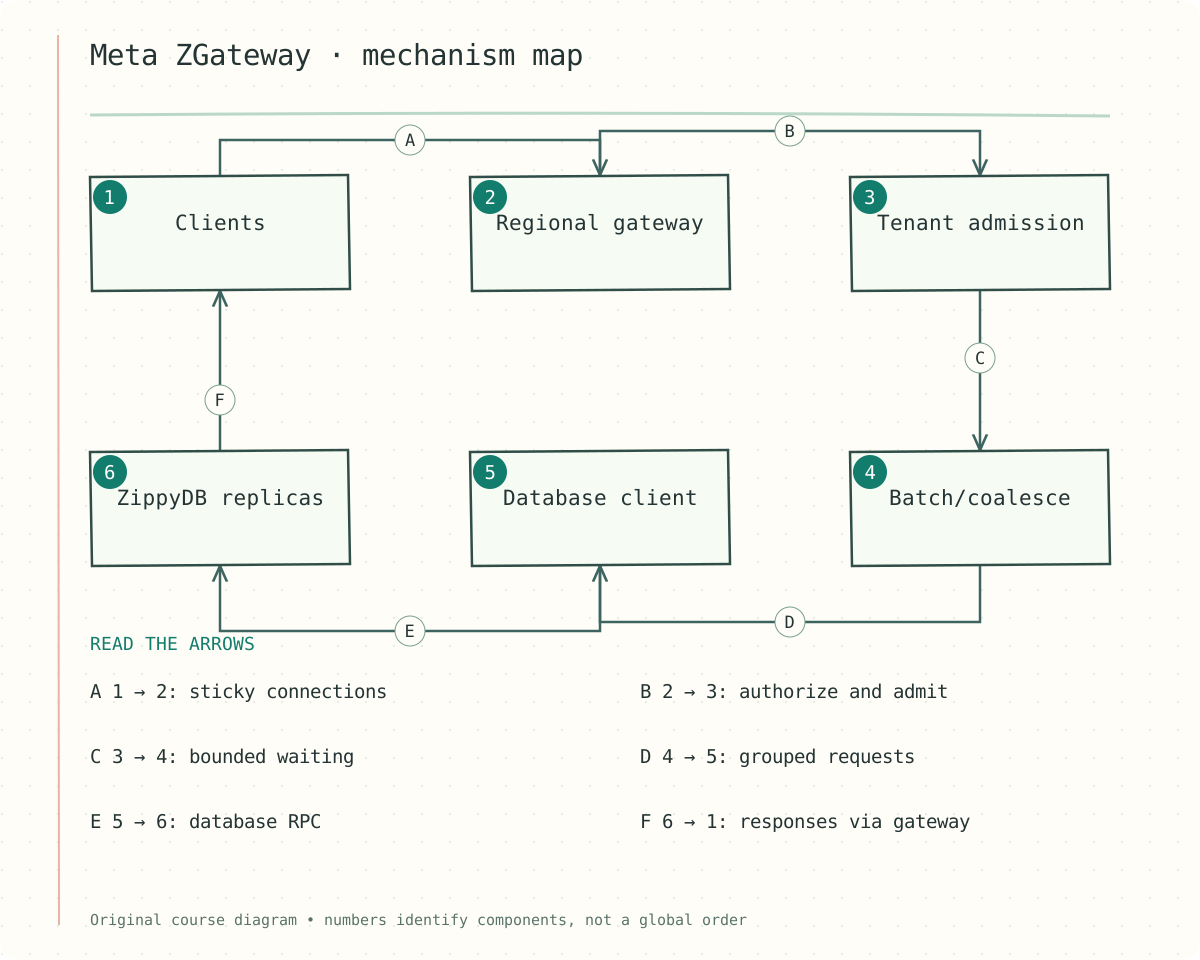
Figure — Clients → Regional gateway (sticky connections); Regional gateway → Tenant admission (authorize and admit); Tenant admission → Batch/coalesce (bounded waiting); Batch/coalesce → Database client (grouped requests); Database client → ZippyDB replicas (database RPC); ZippyDB replicas → Clients (responses via gateway)
The numbered components identify responsibilities. Follow the labeled arrows rather than treating the numbers as a global execution order. The scenario later in this lesson shows one concrete sequence.
Step-by-step reasoning
1. Compare connection topologies
For an independent example, 10,000 clients each opening 100 backend connections create one million connections. If clients instead use four gateway connections and 100 gateways each maintain 100 backend connections, the simplified total is 50,000. Real routing and replication alter this arithmetic; state every assumption.
2. Budget the extra hop
A proxy adds latency and a new failure boundary. Batching can reduce per-request overhead, but a linger interval spends part of the deadline. Flush by time, byte count or item count, and reject work when in-flight capacity is exhausted rather than accumulating unlimited promises.
3. Isolate noisy neighbors
A global concurrency cap protects the tier but does not guarantee fairness. Give tenants bounded queues and scheduling shares, with an explicit policy for borrowing unused capacity. Report rejections by tenant and priority so aggregate success does not hide starvation.
4. Roll out reversibly
For a generic proxy migration, route a small percentage of one workload through the tier. Compare latency, errors, authorization decisions and backend load. Keep a rollback route while preserving protocol compatibility. Do not remove the old path until failover drills and capacity limits are understood.
Contracts and state
The following sketch makes the decision boundary concrete. Field names and capacity assumptions are illustrative; adapt them to the stated product contract.
request(tenant,deadline,priority,shard,key)
batch_key(tenant,shard,consistency_mode)
budget(tenant,max_pending,max_inflight)
route(region,tier,weight,configuration_version)
Worked example
Original exercise: a gateway groups ten compatible reads into one backend request. Then inject a slow backend. The group must respect the earliest relevant deadline and release memory on completion or cancellation. Mixing authorization scopes or incompatible consistency modes merely to make larger batches is incorrect.
Failure walkthrough
Original failure probe: one region fails and traffic spills into a neighbor already at 80% capacity. Blind failover can overload the second region. Reserve headroom, shed low-priority work and cap cross-region retries. A proxy can improve control while still creating a correlated failure domain.
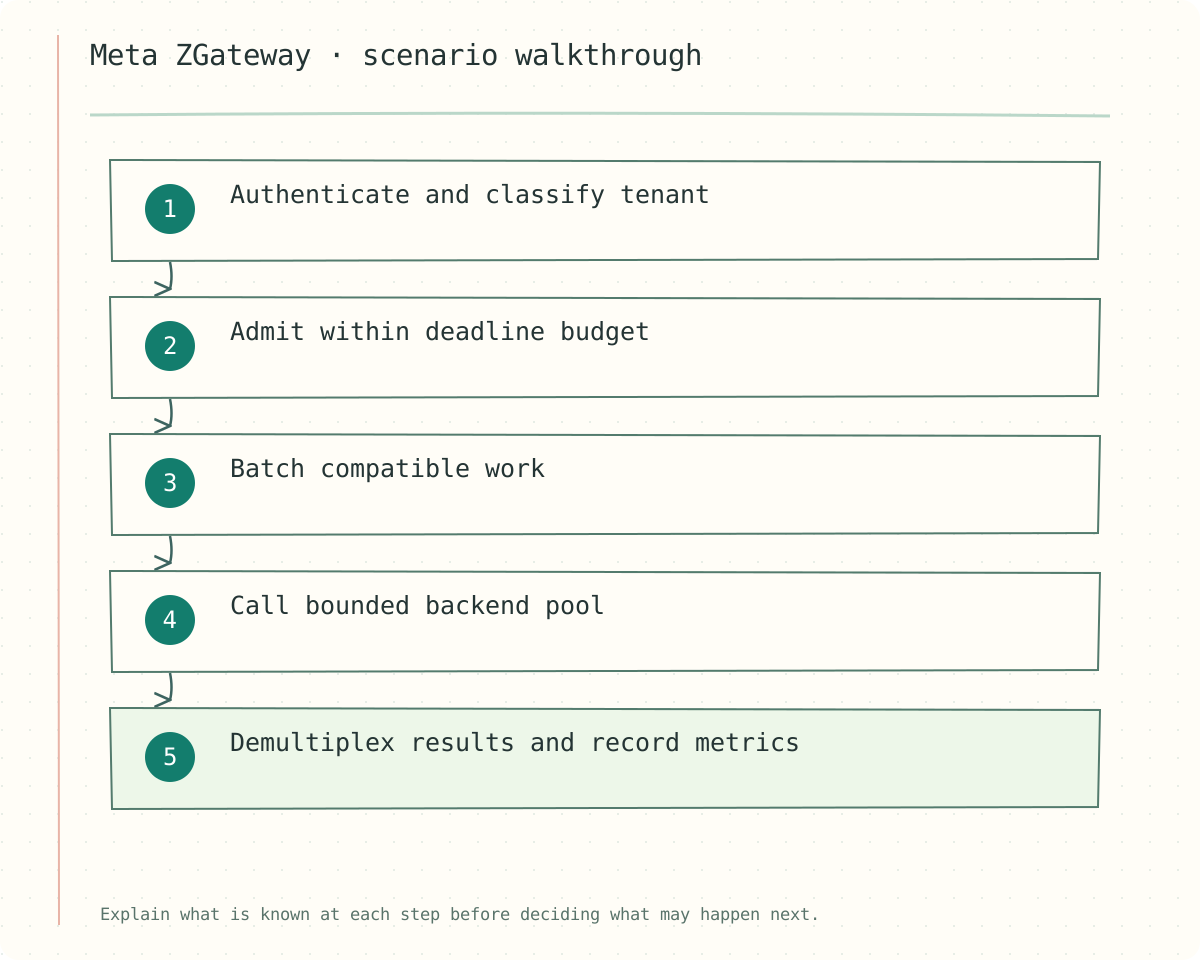
Figure — Authenticate and classify tenant → Admit within deadline budget → Batch compatible work → Call bounded backend pool → Demultiplex results and record metrics
Decisions and trade-offs
| Decision | Useful when | Cost to explain |
|---|---|---|
| Adopt the mechanism | The same workload constraint is demonstrated | Validate with your own measurements |
| Keep a simpler design | Your scale and guarantees are already met | Monitor the trigger for changing it |
Check your understanding
Why is fewer connections not sufficient evidence that a proxy is a good design?
Show answer and explanation
Answer: The extra hop can add tail latency, correlated failures, memory pressure and operational complexity. Evaluate useful throughput, isolation, rollback and behavior under backend slowness as well as connection count.
Primary documentation
Read the first-party engineering account or official technical reference. Company engineering posts describe the scope and date of that publication; the interview reconstruction and scenarios here are original teaching examples.
Continue the connection
Study API Gateway and explain which guarantee from this lesson carries into that topic.
Why is fewer connections not sufficient evidence that a proxy is a good design?
Your design draft
Clarify assumptions, explain your approach, and test the difficult cases. Save your draft, then compare it with the study notes.
Self-review checklist
Self-guided practice. Automated AI feedback and code execution are not connected.