Question Breakdowns Overview
A question breakdown is a worked example of the delivery framework, not a diagram to memorize.
A question breakdown is a worked example of the delivery framework, not a diagram to memorize. Each case starts from product behavior and derives the correctness rule, data model, dominant bottleneck, and failure paths. Use this index to select practice by the mechanism you want to improve.
The mechanism at a glance
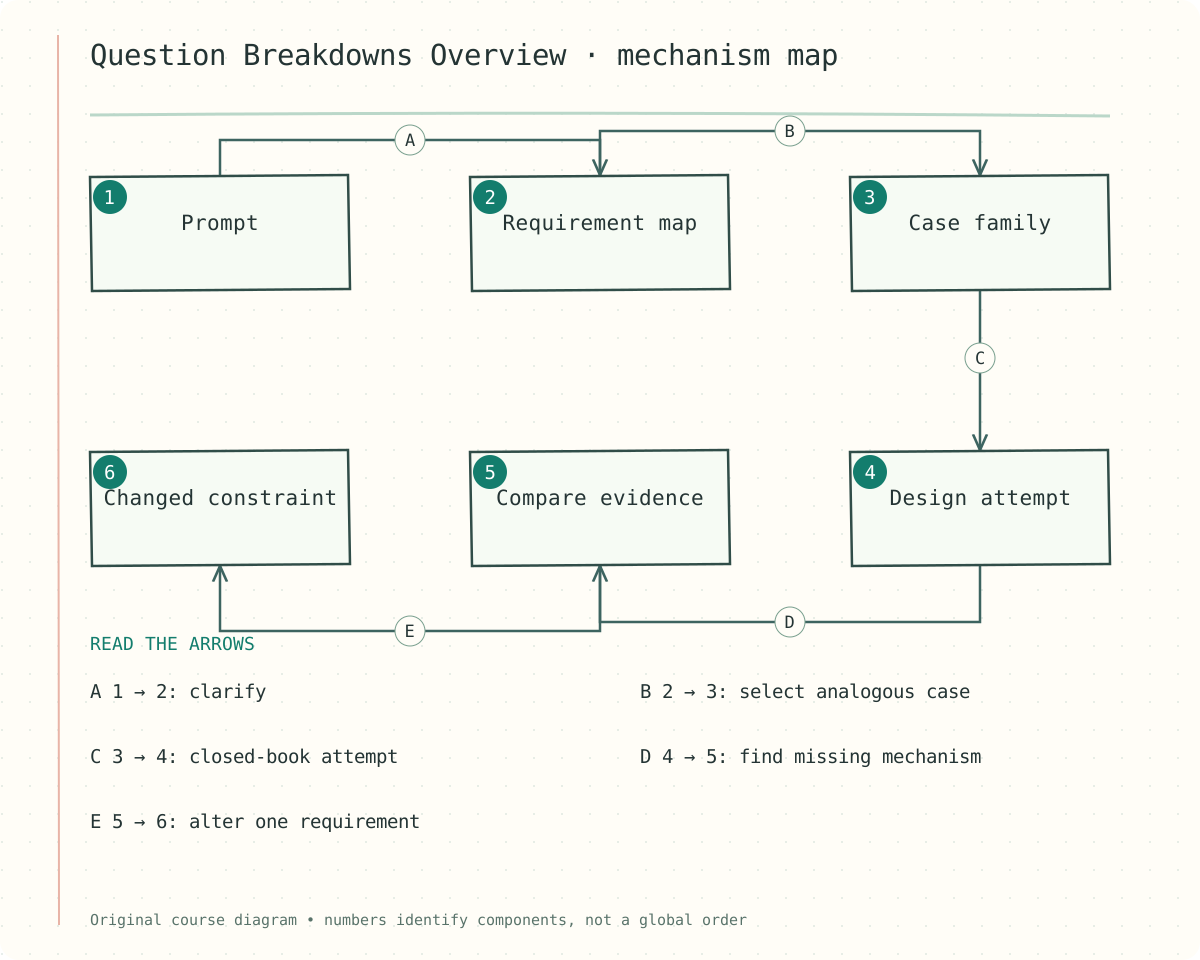
Figure — Prompt → Requirement map (clarify); Requirement map → Case family (select analogous case); Case family → Design attempt (closed-book attempt); Design attempt → Compare evidence (find missing mechanism); Compare evidence → Changed constraint (alter one requirement)
The numbered components identify responsibilities. Follow the labeled arrows rather than treating the numbers as a global execution order. The scenario later in this lesson shows one concrete sequence.
Step-by-step reasoning
1. 1 · Frame
Start with the prompt and the relevant activity: Bitly, Dropbox, Local Delivery Service, Ticketmaster, FB News Feed, Tinder, LeetCode, WhatsApp, Rate Limiter, YouTube, FB Live Comments, YouTube Top K, Uber, Web Crawler, Ad Click Aggregator, FB Post Search, Yelp, Instagram, Strava, or Distributed Cache.
2. 2 · Model
Continue with Online Auction, Job Scheduler, News Aggregator, Price Tracking Service, Notification System, Robinhood, Google Docs, Payment System, Metrics Monitoring, Online Chess, ChatGPT, and Flash Sale. Cases span reservations, feeds, real-time collaboration, streaming aggregates, money movement, and burst control.
3. 3 · Scale
Before reading a solution, create a one-page answer: requirements, one workload estimate, APIs, entities and ownership, critical path, one deep dive, and one failure. Then compare your evidence with the case chapter and practice rubric. Change a requirement and explain which component or guarantee changes.
4. 4 · Recover
Use case families to transfer mechanisms: contested inventory (Ticketmaster, Online Auction, Flash Sale), concurrent edits (Google Docs), dispatch and geography (Local Delivery Service, Uber, Yelp, Strava), event aggregation (YouTube Top K, Ad Click Aggregator), and durable tasks (LeetCode, Job Scheduler). Similarity is a prompt for comparison, not proof the systems are identical.
Contracts and state
The following sketch makes the decision boundary concrete. Field names and capacity assumptions are illustrative; adapt them to the stated product contract.
Prompt -> requirements -> model -> bottleneck -> invariants -> failure -> trade-off
Case families: contention; feeds/search; location; async work; real-time edits; streaming aggregation
Worked example
Practice Online Chess first for authoritative turn transitions, then Online Auction for competing offers. Both need a deterministic state owner and retry handling, but chess validates legal moves and turn sequence while an auction also defines close time, bid acceptance, and winner finalization.
Failure walkthrough
A candidate memorizes a known architecture and misses that the interviewer changes privacy or freshness. The case method forces a return to requirements and revises the affected boundary, rather than preserving an obsolete box diagram.
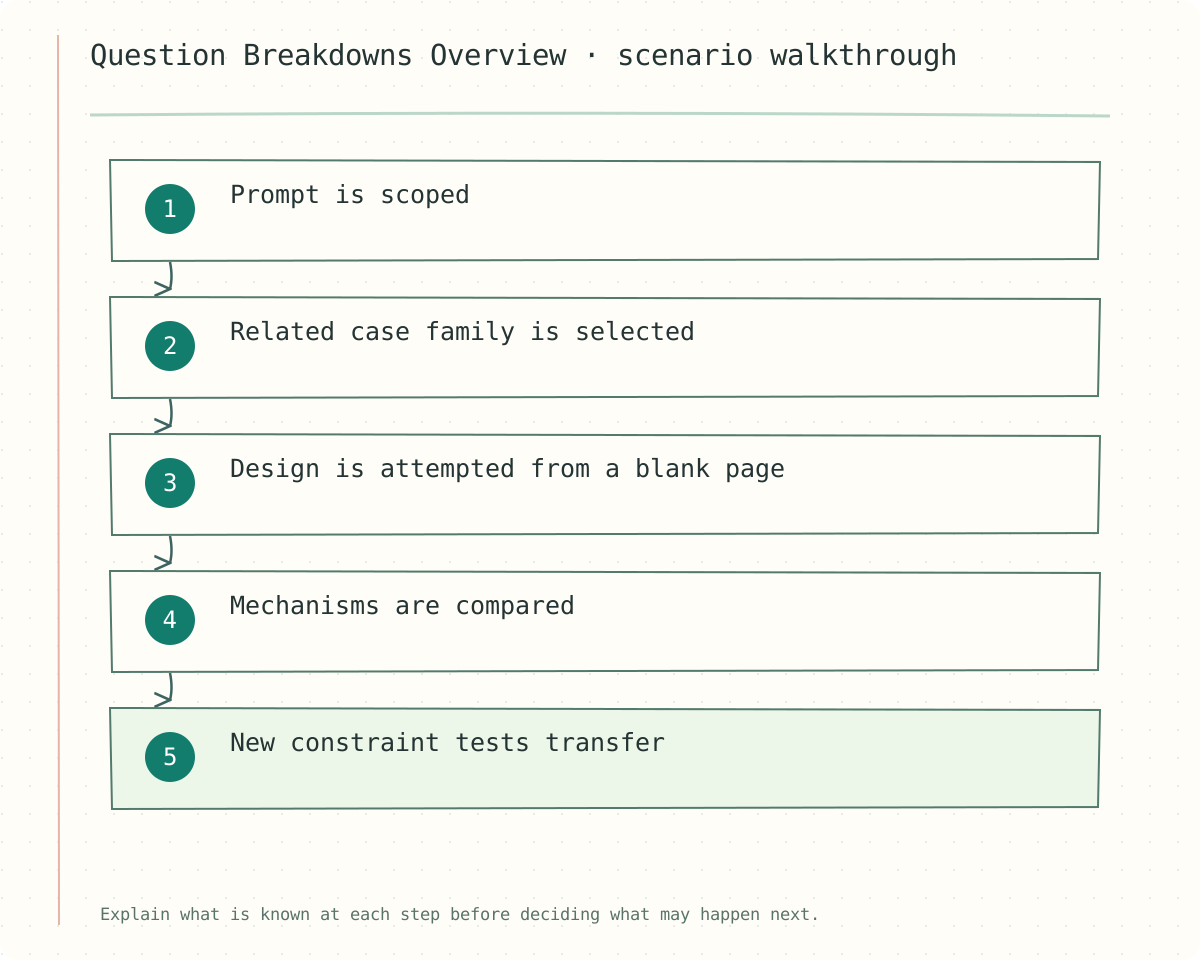
Figure — Prompt is scoped → Related case family is selected → Design is attempted from a blank page → Mechanisms are compared → New constraint tests transfer
Decisions and trade-offs
| Practice goal | Suggested cases | Transfer question |
|---|---|---|
| Contention | Ticketmaster, Auction, Flash Sale | What is the atomic winner transition? |
| Location | Local Delivery, Uber, Yelp, Strava | How stale can the spatial index be? |
| Realtime edits | Google Docs, Online Chess | What is ordered and replayed? |
| Streams and ranking | Ad Click, YouTube Top K, Metrics | What are event time and correction rules? |
| Async work | LeetCode, Scheduler, Notification | What does a retry repeat? |
Check your understanding
Choose one case you already know. Change its most important quality requirement and explain what must change in its API, data model, and failure behavior.
Show answer and explanation
Answer: Return to the changed requirement first. For stronger consistency, put the invariant at an authoritative write boundary; for stricter freshness, shorten or avoid a projection path; for lower latency, add a bounded derived path while checking privacy and staleness. Explicitly state the new cost.
Open a chapter
- Bitly
- Dropbox
- Local Delivery Service
- Ticketmaster
- FB News Feed
- Tinder
- LeetCode
- Rate Limiter
- YouTube
- FB Live Comments
- YouTube Top K
- Uber
- Web Crawler
- Ad Click Aggregator
- FB Post Search
- Yelp
- Strava
- Distributed Cache
- Online Auction
- Job Scheduler
- News Aggregator
- Price Tracking Service
- Notification System
- Robinhood
- Google Docs
- Payment System
- Metrics Monitoring
- Online Chess
- ChatGPT
- Flash Sale
Choose one case you already know. Change its most important quality requirement and explain what must change in its API, data model, and failure behavior.
Your design draft
Clarify assumptions, explain your approach, and test the difficult cases. Save your draft, then compare it with the study notes.
Self-review checklist
Self-guided practice. Automated AI feedback and code execution are not connected.