Time Series Databases
A time-series system stores measurements keyed by time and one or more dimensions.
A time-series system stores measurements keyed by time and one or more dimensions. Design around bounded time-range queries, ingestion rate, cardinality, retention, and correction needs. “Millions of points per second” is not enough to pick a store: an unbounded set of unique label combinations can exhaust memory even when byte volume looks manageable.
The mechanism at a glance
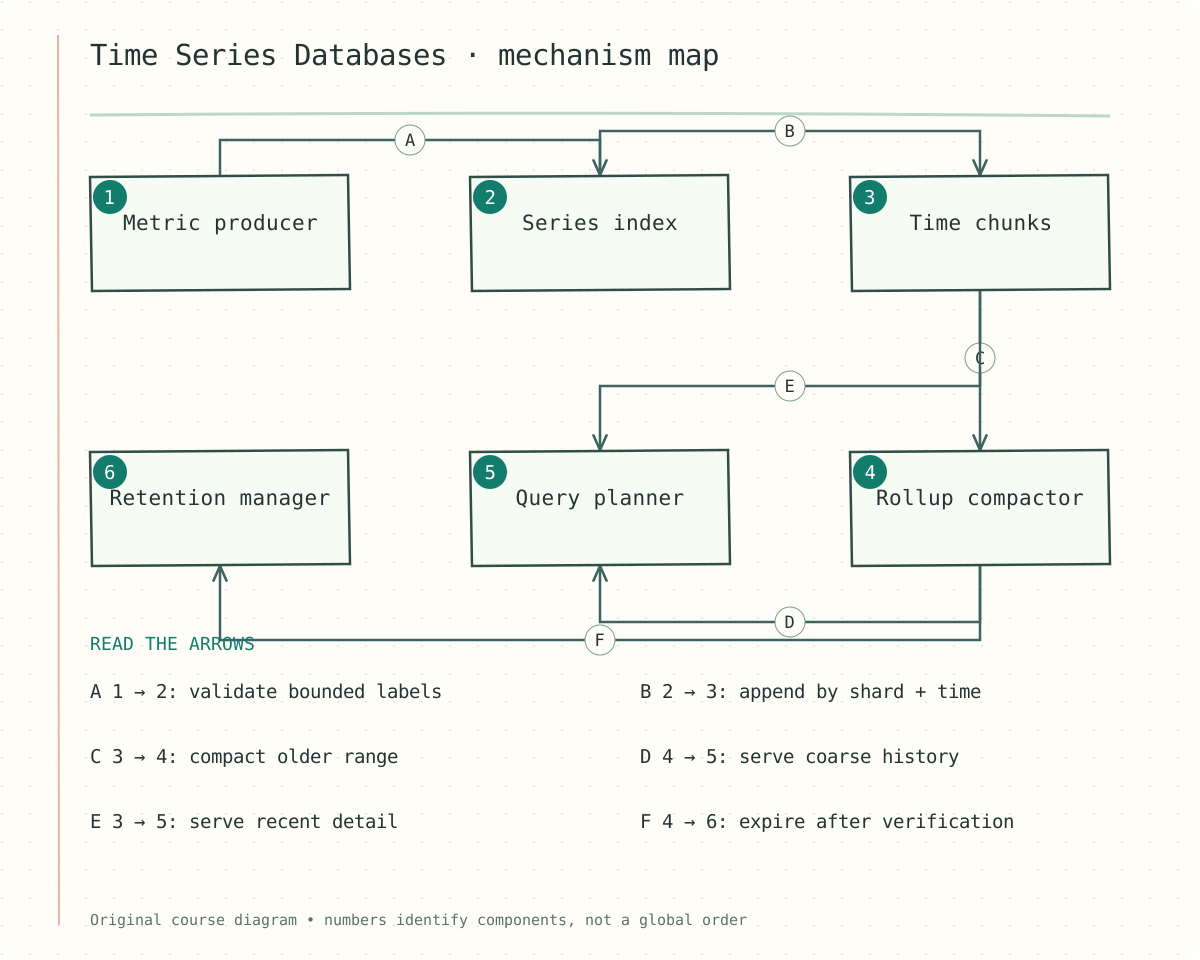
Figure — Metric producer → Series index (validate bounded labels); Series index → Time chunks (append by shard + time); Time chunks → Rollup compactor (compact older range); Rollup compactor → Query planner (serve coarse history); Time chunks → Query planner (serve recent detail); Rollup compactor → Retention manager (expire after verification)
The numbered components identify responsibilities. Follow the labeled arrows rather than treating the numbers as a global execution order. The scenario later in this lesson shows one concrete sequence.
Step-by-step reasoning
1. 1 · Frame
Clarify sample shape, timestamp source, write rate, query windows, resolution, retention, and late corrections. Separate operational dashboards from forensic or billing records. Define whether a chart may be approximate and how quickly a new sample must appear. Estimate both bytes and active series: series cardinality often drives index and metadata costs.
2. 2 · Model
Use a logical key of measurement plus bounded dimensions, with timestamped values. Reject or normalize unbounded labels such as raw user IDs unless a query need justifies them. Assign event time and ingest time separately. Partition by time and a stable shard key; keep series metadata distinct from compressed sample blocks.
3. 3 · Scale
Append samples into time-ordered chunks, compress them, and use time and label indexes to prune scans. Retention can delete whole old blocks efficiently. Downsampling produces coarser rollups for long ranges, while raw data remains available for the promised interval. Avoid downsampling across reset or counter-wrap boundaries without reset-aware logic.
4. 4 · Recover
Late data may target a sealed block; choose a bounded correction horizon and a repair path. A compaction job should be idempotent and publish a new block version before deleting old inputs. Protect query paths from expensive high-cardinality selections and monitor active series, ingestion lag, dropped samples, and storage growth.
Contracts and state
The following sketch makes the decision boundary concrete. Field names and capacity assumptions are illustrative; adapt them to the stated product contract.
Series(key, dimensions, unit, schema_version)
Sample(series_id, event_time, ingest_time, value)
Chunk(series_id, time_range, encoding, checksum)
Rollup(series_id, interval, start_time, aggregate, revision)
Query = dimensions + bounded time range + resolution
Worked example
A dashboard asks for one-minute CPU averages over 30 days. The system reads daily rollups rather than scanning every raw point. An incident investigator asks for a five-minute interval from yesterday; raw samples remain available during the declared raw-retention period. Both queries carry the same bounded dimensions, so neither creates a scan over every tenant series.
Failure walkthrough
A client attaches a unique request ID as a metric label, creating a new series per request. Ingestion still succeeds initially, but series indexes and memory grow much faster than sample bytes. Enforce label budgets, drop or route unsuitable dimensions to logs/traces, and make rejected-label behavior observable. Never silently merge semantically distinct metrics.
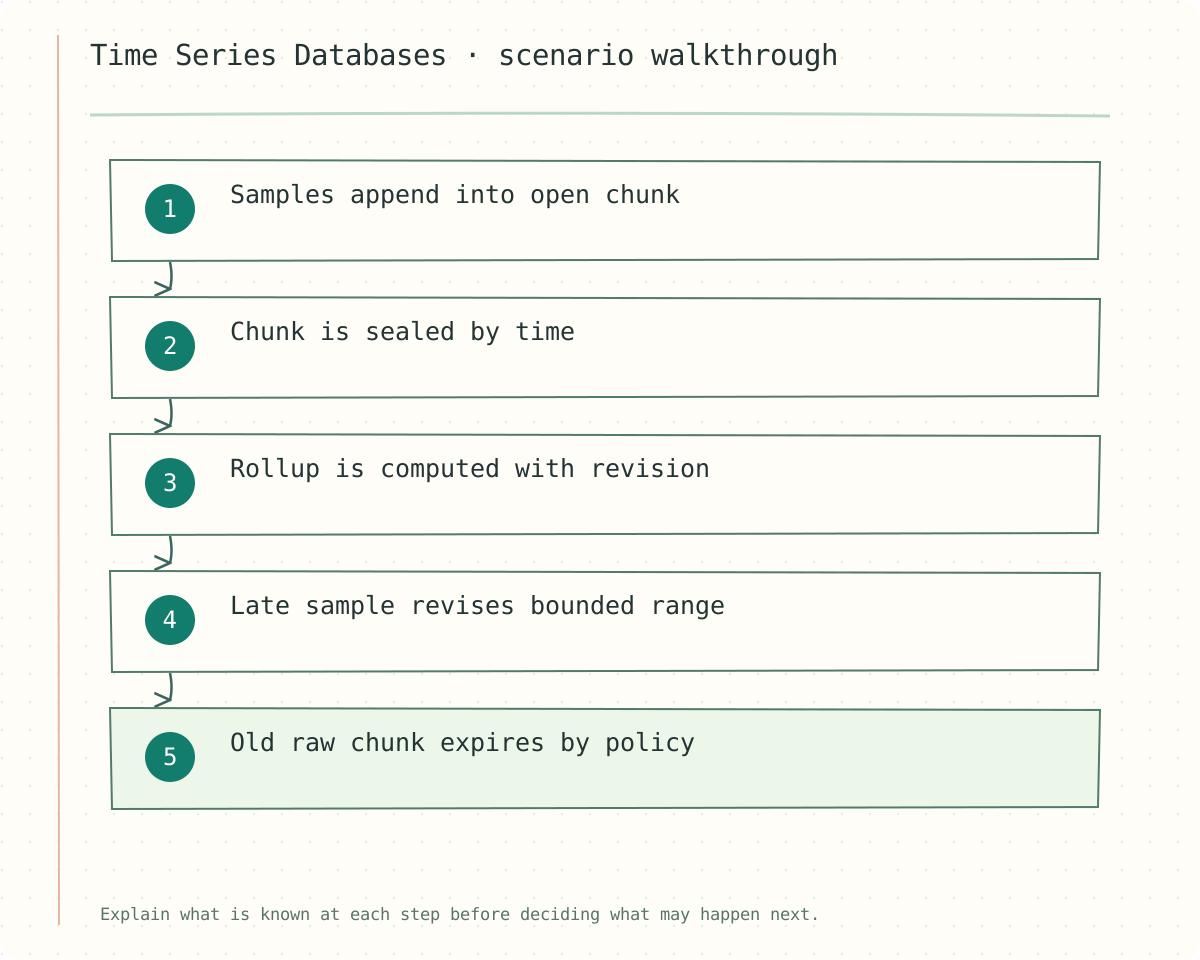
Figure — Samples append into open chunk → Chunk is sealed by time → Rollup is computed with revision → Late sample revises bounded range → Old raw chunk expires by policy
Decisions and trade-offs
| Choice | Good fit | Cost |
|---|---|---|
| Time partitioned chunks | Append-heavy bounded range reads | Late corrections and compaction |
| Rollups | Long-range charts | Fine detail is irrecoverable after raw expiry |
| High-cardinality labels | Only when queries require them | Index and memory growth |
| Separate event archive | Audits and rebuilds | More storage and delayed queries |
Check your understanding
Design metrics retention for raw samples, hourly charts, and one late correction that arrives after a block was compacted.
Show answer and explanation
Answer: Keep raw data for a shorter explicit interval and hourly rollups for the longer chart horizon. Track event and ingest time; late corrections within a bounded horizon revise the relevant rollup version. Corrections outside that horizon require a replay/archive path or are rejected by contract. Publish compaction output atomically and retain source blocks until verification.
Primary documentation
Read the first-party engineering account or official technical reference. Company engineering posts describe the scope and date of that publication; the interview reconstruction and scenarios here are original teaching examples.
Continue the connection
Study Metrics Monitoring and explain which guarantee from this lesson carries into that topic.
Budget series cardinality and retention
A time series is identified by a metric and label set, then contains timestamped values. Millions of unique label combinations can cost more than a high sample rate for a small stable set. User IDs, request IDs and free-form URLs are dangerous labels when they grow without bound.
Time partitioning supports retention and range scans; compression benefits from regular timestamps and related values. Downsampling lowers long-term cost but changes available questions. An hourly average cannot reconstruct a one-minute spike, and averaging percentiles from separate instances does not generally produce the combined percentile. Preserve suitable histogram buckets or raw observations for the required analysis.
Separate ingestion freshness, query latency and alert delay. Late or out-of-order samples need a policy. Missing data is distinct from zero. Delete or compact whole expired blocks where possible rather than generating billions of individual delete operations. Replication and remote archive paths must have clear replay and deduplication behavior.
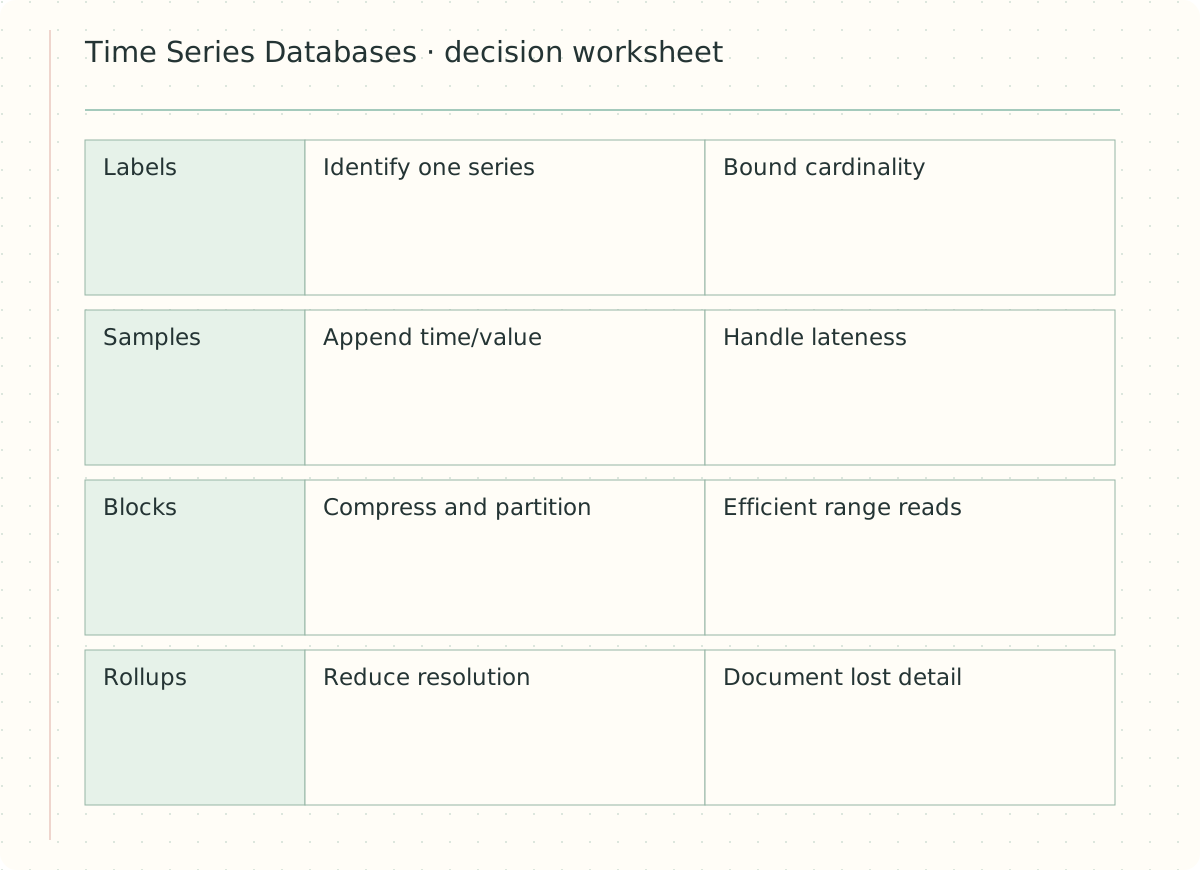
Figure — A decision worksheet for Time Series Databases: read the mechanism and its guarantee together.
Operational sketch
series = metric_name + normalized label set
sample = timestamp + numeric value
raw: 15-second resolution for 7 days
rollup: 5-minute buckets for 90 days
retention policy states which peaks are preserved
A tempting mistake
Downsampling before defining alert requirements can erase the evidence for incidents. A cheap dashboard query is not enough if the data model cannot answer the operational question.
Transfer exercise
Why is endpoint=/orders/{id} a safer label than the full request URL?
Show answer and explanation
Answer: The normalized route has bounded cardinality. Full URLs create a distinct series for many IDs and query strings, increasing index and memory cost.
Design metrics retention for raw samples, hourly charts, and one late correction that arrives after a block was compacted.
Your design draft
Clarify assumptions, explain your approach, and test the difficult cases. Save your draft, then compare it with the study notes.
Self-review checklist
Self-guided practice. Automated AI feedback and code execution are not connected.