Advanced Topics Overview
Advanced topics help when a baseline design hits a specialized data or scale constraint.
Advanced topics help when a baseline design hits a specialized data or scale constraint. They are not mandatory decorations. This map connects spatial search, time-series storage, approximate data structures, vector retrieval, and CDC to the workload signal that makes each useful.
The mechanism at a glance
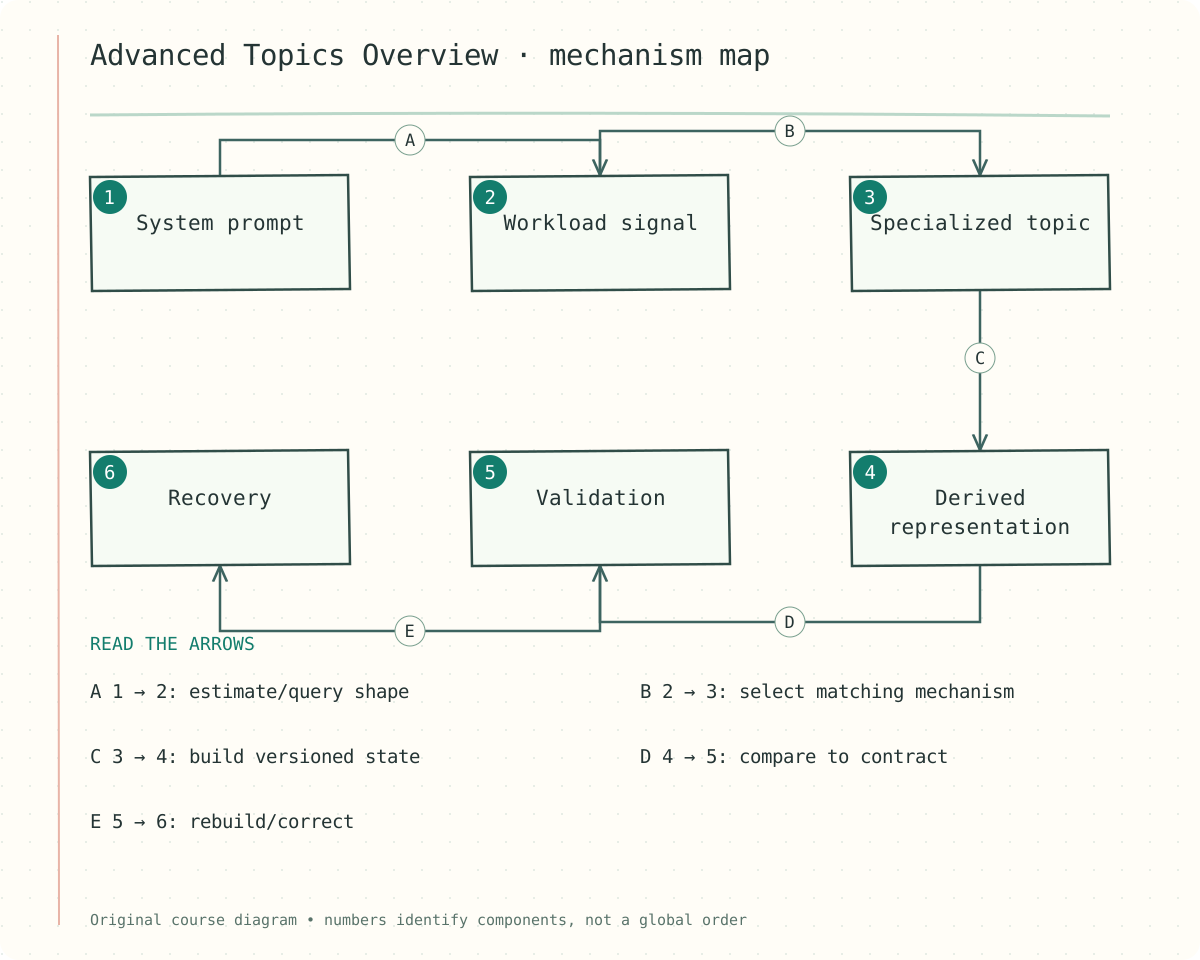
Figure — System prompt → Workload signal (estimate/query shape); Workload signal → Specialized topic (select matching mechanism); Specialized topic → Derived representation (build versioned state); Derived representation → Validation (compare to contract); Validation → Recovery (rebuild/correct)
The numbered components identify responsibilities. Follow the labeled arrows rather than treating the numbers as a global execution order. The scenario later in this lesson shows one concrete sequence.
Step-by-step reasoning
1. 1 · Frame
Proximity Search handles geographic candidate retrieval with spatial indexes and exact distance checks. Time Series Databases handles timestamped measurements, retention, and downsampling. Data Structures for Big Data covers approximate membership, cardinality, frequency, and quantiles with explicit error.
2. 2 · Model
Vector Databases support approximate semantic nearest-neighbor retrieval, model-versioned indexes, filtering, and reranking. Change Data Capture publishes committed row changes to downstream projections, with snapshot boundaries, duplicates, ordering, and schema evolution. These mechanisms address different representations of data.
3. 3 · Scale
Each chapter should be paired with a measurable reason: query shape, cardinality, error budget, semantic retrieval quality, or projection freshness. Preserve authoritative state elsewhere when the index is derived. Measure the approximation or lag against a reference and define correction/rebuild behavior.
4. 4 · Recover
Advanced mechanisms can fail at boundaries not visible in a happy-path diagram: cell boundaries, cardinality spikes, model mismatch, late events, schema changes, and index deletes. Add one of these probes to practice only after baseline requirements and correctness are clear.
Contracts and state
The following sketch makes the decision boundary concrete. Field names and capacity assumptions are illustrative; adapt them to the stated product contract.
Workload signal -> specialized representation -> query path -> accuracy/freshness -> rebuild or correction
Location | timestamp | approximate summary | embedding | committed row changes
Worked example
A place search needs “within five miles,” not just “same map cell.” A spatial index retrieves candidates; exact distance filters them. Search results use current eligibility checks. This differs from vector semantic similarity, which ranks model-space closeness and requires a model-quality measure.
Failure walkthrough
A team uses a sketch for an exact financial balance, or a vector score as access control. In both cases the representation is used beyond its contract. Keep exact authoritative state and enforce permission independently of candidate ranking.
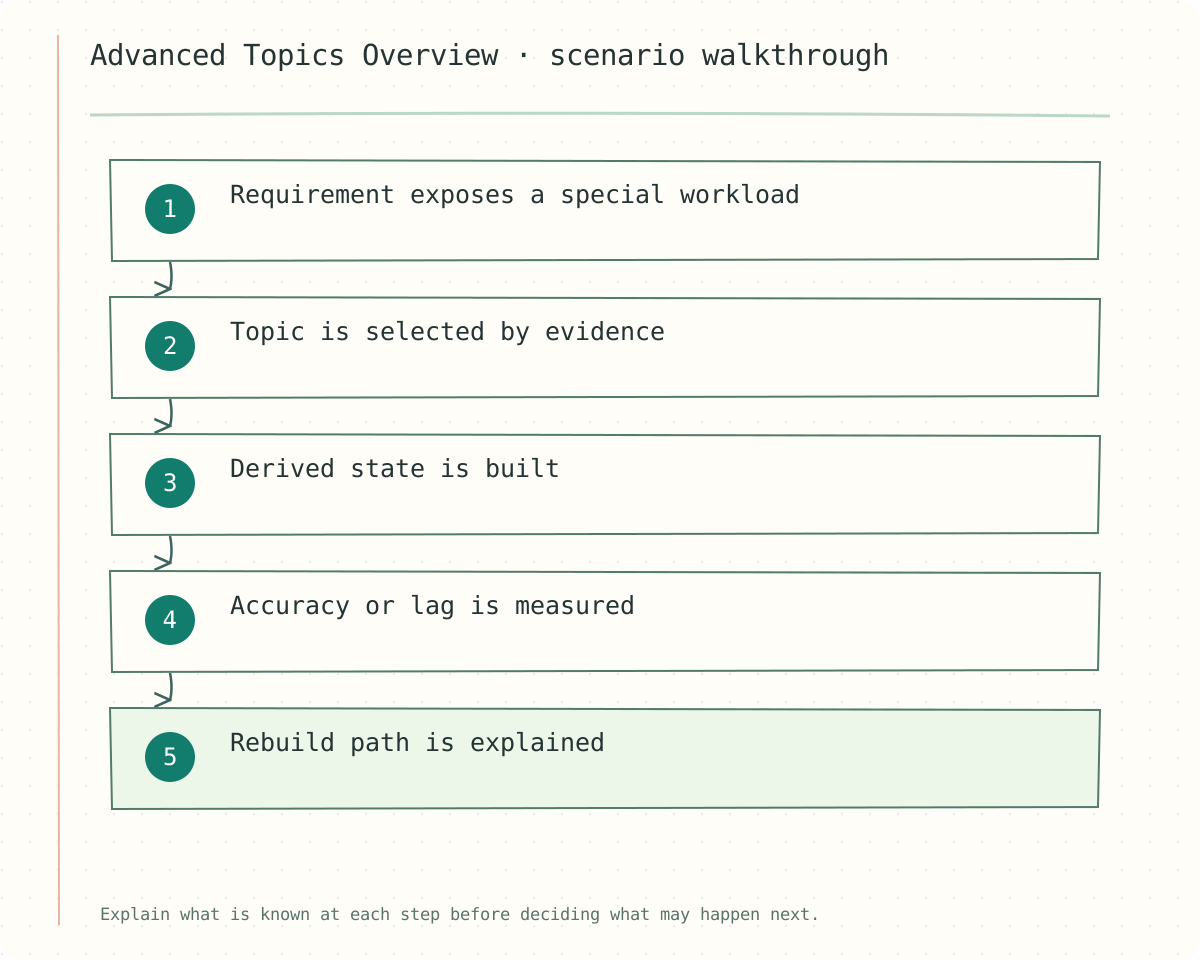
Figure — Requirement exposes a special workload → Topic is selected by evidence → Derived state is built → Accuracy or lag is measured → Rebuild path is explained
Decisions and trade-offs
| Signal | Topic | Validation |
|---|---|---|
| Geographic radius | Proximity Search | Boundary and distance accuracy |
| Timestamped measurements | Time Series Databases | Cardinality and retention |
| Memory bound with tolerated error | Big Data Structures | Error versus exact sample |
| Semantic nearest neighbors | Vector Databases | Labeled recall and ACL |
| Replicate database changes | Change Data Capture | Offsets, duplicates, schema, lag |
Check your understanding
Choose one advanced topic for a system you are designing. State the workload signal, the new representation, its error/freshness contract, and rebuild strategy.
Show answer and explanation
Answer: A justified advanced topic has an explicit trigger and measurable contract. Use its specialized structure only for the path it improves, keep authority clear, and validate against exact or current state where required. If the requirement does not need its behavior, the baseline is simpler.